
Real-time cost, risk, and revenue recovery visibility.
Alphiniti Recovery Management gives provider practices visibility and recovery of uncaptured revenue; health plans and TPAs early visibility into emerging high-cost claimants and stop-loss risk, helping the self-funded clients you serve reduce healthcare costs.
Stop-loss risk you can see
before the claim lands.
Real-time stop-loss risk scoring, emerging high-cost claimant alerts, and portfolio-wide corridor burn visibility — so you can help your self-funded clients reduce healthcare costs.
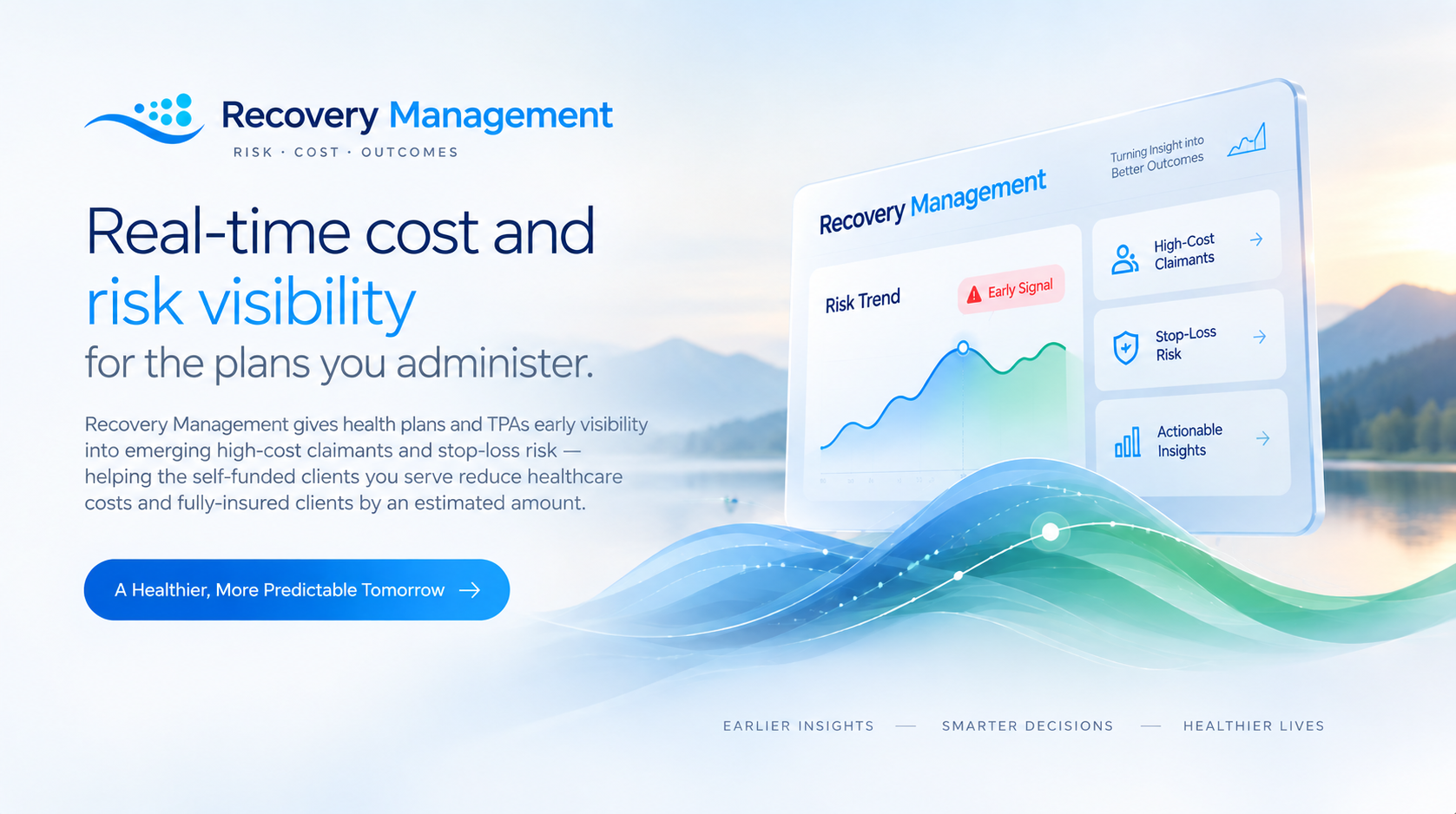
Real-time stop-loss risk scoring
See risk exposure across your book as it develops, not after a claim lands.
Emerging high-cost claimant alerts
Identify members trending toward high-cost claims early enough to actually intervene.
Cost reduction for your clients
Help self-funded and fully-insured clients reduce healthcare costs, with the numbers to show it.
Aggregate Stop-Loss Corridor Burn; Portfolio Distribution
Looking to capture lost revenue or need help with stop-loss management?
If you administer a provider practice, self-funded or fully-insured plan and want to see what real-time revenue recovery, risk, and cost visibility could look like for your book, we'd like to talk.
Your EHR was built to document care.
Not to fund it.
The average physician practice leaves $180,000–$400,000 in annual CMS reimbursement uncaptured; not because they aren't delivering the care, but because their EHR has no infrastructure to document, track, and bill for it.
Revenue Left on the Table
CCM, RPM, AWV, and TCM programs pay $62–$239 per patient per service; but require documentation infrastructure your EHR was never designed to provide.
Administrative Burden
Prior authorization consumes 45+ minutes per request. Manual intake adds 2–3 hours of non-clinical work per physician per day.
Clinical Risk You Cannot See
Your EHR only knows what happens inside your practice. Drug interactions from other prescribers are invisible.
Value-Based Performance Blind
Practices discover quality measure performance at year-end; when it's too late to act.
Annual Revenue Gap; 2,000 Patient Practice
We're helping practices capture the revenue they've already earned
If you run a physician practice or hospital system and want to see what real-time revenue intelligence could look like for your operations, we'd like to talk.
Dental and medical records live in separate worlds.
The patient pays the price.
Oral health is a window into systemic health, yet dental and medical systems barely communicate. Periodontal disease worsens diabetes, dental abscesses trigger cardiac events, and Medicare Advantage members leave preventive dental benefits unused. Every gap in the medical-dental record is a missed diagnosis, a missed intervention, and a missed dollar. Alphiniti Dental Continuity unifies both sides before the patient falls through the crack.
For Medical Practices & MA Plans
Disconnected Records
Your diabetic patient's periodontal chart sits in a dental EHR you cannot see. The clinical correlation stays invisible until it becomes an inpatient admission.
Unused Member Benefits
MA members with embedded dental benefits utilize them at less than 30%. STAR measure gaps widen while preventive benefits sit untouched.
Manual Clearance Friction
Dental procedures on medically complex patients stall for days while offices fax paperwork back and forth. 48-hour urgent timelines are impossible.
Risk You Can't Score
No composite dental risk model exists in the medical record. Periodontal stage, medications, and behavioral factors never combine into a single actionable score.
For Self-Insured Employers & Brokers
Hidden Medical Cost Drivers
Untreated periodontal disease inflates diabetes and cardiovascular claims by 25–40%. These costs surface as medical claims with no dental context.
Fragmented Vendor Silos
Dental, medical, vision, and pharmacy vendors each keep their own records. No single view of the member's total health and cost trajectory.
No Oral-Systemic Analytics
Stop-loss renewals never factor in dental-driven medical risk. Employers cannot defend or reduce exposure from the dental side of the ledger.
Benefits Designed in a Vacuum
Dental benefit designs are optimized for premium, not for downstream medical cost avoidance. Preventive utilization stays low; emergency spend climbs.
Untreated Dental Disease → Annual Medical Cost Drag by Population Segment
We're building the medical-dental continuity layer
If you manage a dental practice, medical group, or MA plan and want to close the gap between dental and medical records, we'd like to talk.
What does it mean to recover the revenue
you've already earned?
CMS pays $62–$239 per patient per service for CCM, RPM, AWV, and TCM programs. RiskFlow's population health tools drive $135 per life in avoided medical cost. These benchmarks show what's recoverable when the right infrastructure is in place.
Chronic Care Management
CMS pays $40–$100 PMPM for CCM. A 2,000-patient practice with 40% enrollment recovers $384K/year — care you're already delivering but not documenting.
Remote Patient Monitoring
RPM reimburses $50–$120 per device per month. 20% enrollment on a 2,000-patient panel yields $94K/year in new revenue.
Annual Wellness Visits
AWVs pay $180 per visit. 35% completion rate on a Medicare panel generates $42K/year — pure preventive care revenue.
Transitional Care Management
TCM pays $150–$240 per episode. 30% capture of discharges yields $28K/year while reducing 30-day readmissions.
Staff Efficiency Recovery
Practices lose 2–3 hours per physician per day to manual administrative work. Automating intake, prior auth, and documentation recovers $384K/year.
High-Cost Claimant Management
Early identification and care management of emerging high-cost claimants reduces projected spend by 12% — $9K per intervened member.
Annual Revenue Recovery; 2,000 Patient Practice
Annual Cost & Risk Savings; Health Plan / Employer Benchmarks
See what your numbers could look like
These benchmarks are based on CMS reimbursement rates and industry population health data. Use our interactive calculators to model your specific practice or book of business.